
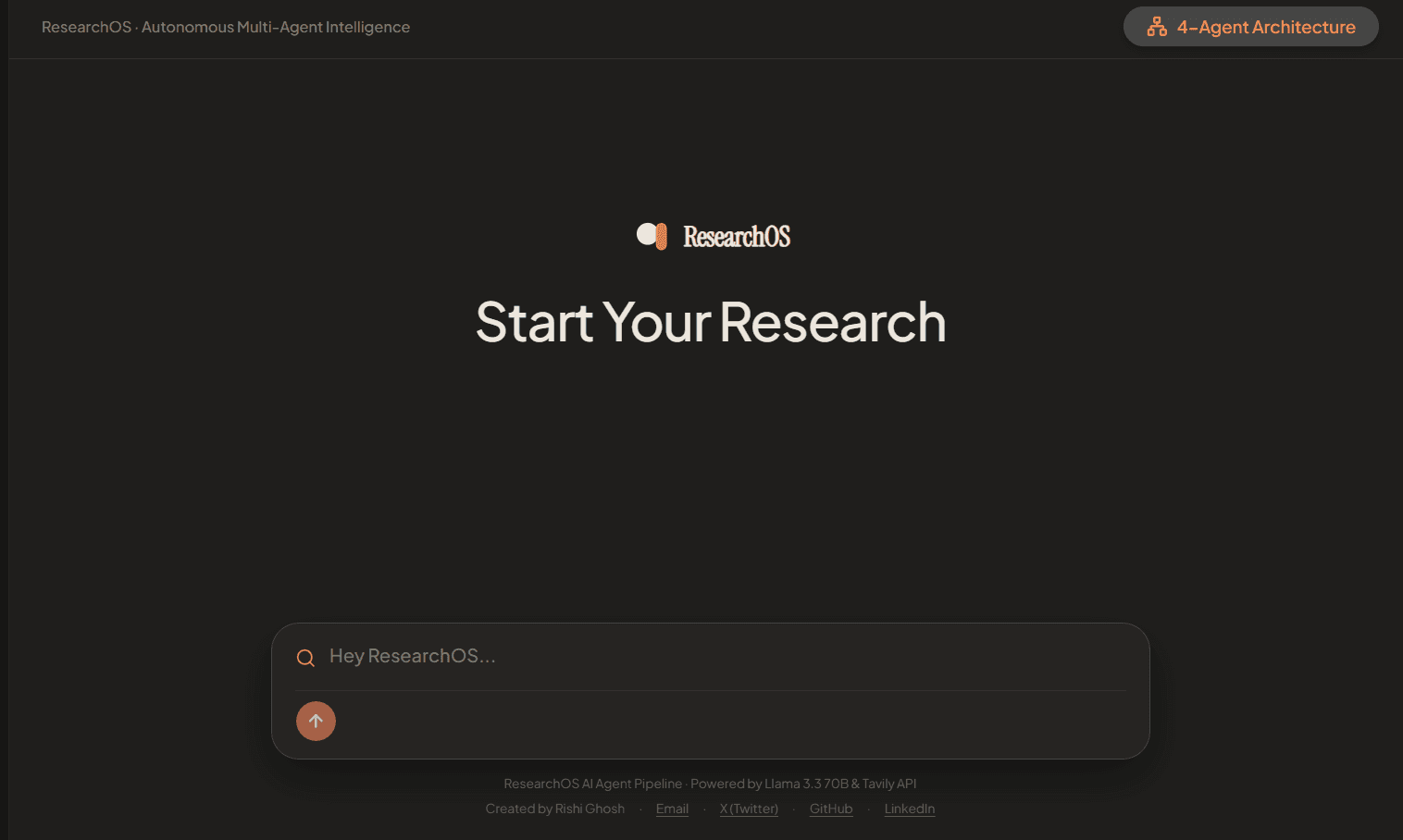
ResearchOS
Autonomous Multi-Agent AI Research & Intelligence Platform.
Timeline
2026
Role
AI Research Platform
Team
Solo
Status
CompletedTechnology Stack
 Vite
ViteResearchOS
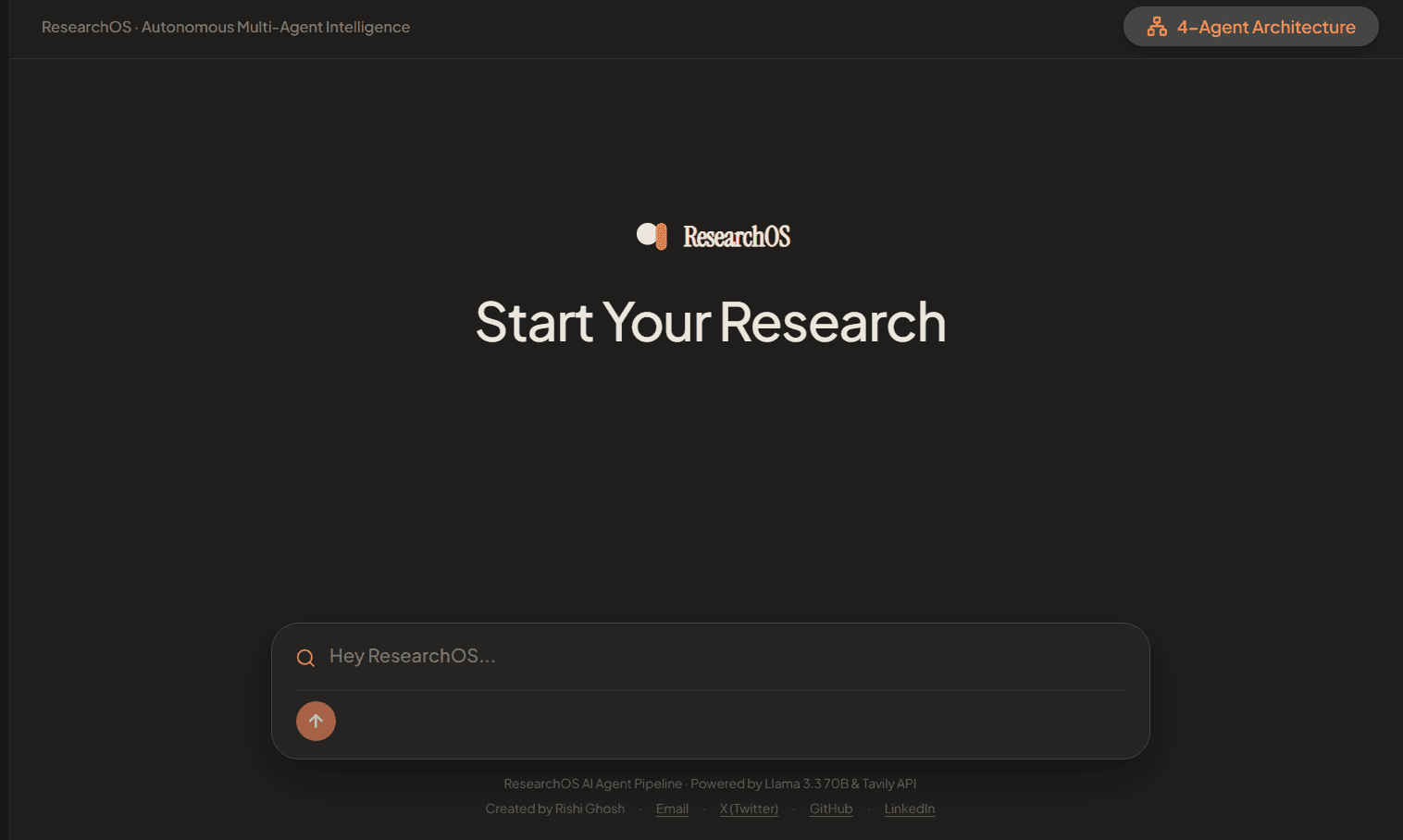
Autonomous Multi-Agent AI Research & Intelligence Platform
Tags
AI Multi-Agent LLM Research Automation Web Intelligence
Description
ResearchOS is an autonomous multi-agent research platform designed to perform deep web research, extract relevant information, synthesize findings, and critically evaluate generated reports.
Instead of relying on a single AI model to perform an entire research task, ResearchOS orchestrates multiple specialized agents through a structured workflow. Each agent is responsible for a specific stage of the research process — from discovering sources and extracting content to generating and auditing the final report.
The platform combines Groq's low-latency Llama 3.3 70B inference, Tavily web search, LangChain, LangGraph, and automated web extraction to create a research pipeline capable of turning a simple research topic into a structured, cited intelligence report.
Overview
Traditional AI research workflows often depend on a single prompt and model to search, reason, summarize, and produce a final answer.
ResearchOS takes a different approach.
The system breaks the research process into specialized stages and allows individual AI agents to perform focused tasks before passing their results to the next stage.
The result is a structured pipeline capable of:
- Discovering relevant web sources
- Extracting high-signal information
- Synthesizing research findings
- Generating structured reports
- Critically evaluating the generated output
- Providing quality scores and improvement suggestions
The Problem
AI-generated research can suffer from several problems:
- Research tasks require multiple disconnected tools.
- Single-agent workflows can produce shallow results.
- Web pages contain large amounts of irrelevant content.
- Generated reports may lack proper source coverage.
- There is often no dedicated quality-control stage.
- Manually researching and synthesizing information is time-consuming.
ResearchOS addresses these problems by transforming research into a multi-stage autonomous workflow.
The Solution
ResearchOS uses four specialized AI agents working together through a structured workflow.
1. Search Agent
Responsible for discovering relevant information across the live web. It uses Tavily Search API and Llama 3.3 70B to:
- Search for relevant sources
- Identify high-authority pages
- Collect search metadata
- Select useful URLs for further analysis
2. Reader Agent
Processes the selected web pages and extracts meaningful content. Using BeautifulSoup4 and HTTP requests, it:
- Fetches target pages
- Removes scripts and navigation noise
- Filters irrelevant content
- Extracts useful textual information
- Prepares clean research context for downstream agents
3. Writer Agent
Acts as the research synthesis layer. It processes the collected information and generates a structured report containing:
- Executive summary
- Key findings
- Supporting evidence
- Conclusions
- Referenced sources
4. Critic Agent
Acts as an adversarial quality-control layer. Instead of immediately returning the generated report, ResearchOS sends it through a dedicated critic that evaluates:
- Research quality
- Coverage
- Accuracy
- Strengths
- Missing information
- Areas for improvement
The critic produces a numerical 0–10 quality score alongside actionable feedback.
Technical Architecture
Frontend
- React 19 & Vite (JavaScript)
- Framer Motion & Lucide React
- React Markdown & Remark GFM
Backend
- Python & FastAPI (Uvicorn)
- ThreadPoolExecutor & REST API architecture
AI Orchestration
- LangChain & LangGraph
- Llama 3.3 70B Versatile via Groq Inference
Research & Extraction
- Tavily Search API
- BeautifulSoup4 & Requests
Deployment
- Vercel (Frontend) & Render (Backend)
- Environment-based configuration
Key Features
- Autonomous Research Pipeline: Single query moves automatically through
Search → Read → Synthesize → Critique. - Live Web Discovery: Connects directly to the web through Tavily to fetch real-time sources.
- Intelligent Content Extraction: Cleans web noise, advertisements, and scripts before LLM processing.
- AI Report Generation: Formats findings into structured executive reports with source citations.
- Adversarial AI Critic: Independent agent evaluates accuracy, depth, and provides a 0–10 quality score.
- Interactive Research Dashboard: Real-time agent status tracking, pipeline visualization, and markdown output canvas.
- High-Speed AI Inference: Powered by Groq Llama 3.3 70B for minimal end-to-end latency.
Technical Challenges & Solutions
Challenge 1: Coordinating Multiple AI Agents
- Problem: Unstructured multi-agent communication causes state confusion and unreliable execution.
- Solution: Designed a deterministic LangChain/LangGraph DAG workflow where each agent passes typed context to the downstream node.
Challenge 2: Extracting Useful Information From Web Pages
- Problem: Raw HTML bloat (navbars, ads, scripts) degrades LLM context limits and accuracy.
- Solution: Implemented a custom BeautifulSoup4 extractor stripping scripts and navigation trees prior to synthesis.
Challenge 3: Improving Research Reliability
- Problem: Hallucinated or shallow research reports with convincing formatting.
- Solution: Integrated an adversarial Critic Agent that performs quality stress-testing and assigns a rubric-based quality score.
Challenge 4: Managing Multi-Stage Latency
- Problem: Sequential agent workflows can cause high response wait times.
- Solution: Leveraged Groq's high-speed inference pipeline with Llama 3.3 70B.
Challenge 5: Real-Time Pipeline Visualization
- Problem: Users need visibility into complex background multi-agent steps.
- Solution: Built an interactive React dashboard that exposes the different research stages and presents the final report through a clean interface.
Impact & Learnings
- Designing stateful multi-agent AI architectures with LangGraph.
- Building high-performance Python FastAPI services integrated with Groq.
- Stripping web noise for high-signal RAG and synthesis pipelines.
- Establishing automated verification and adversarial critique in LLM chains.
- Connecting modern React 19 visual interfaces with streaming AI backends.
Repository Structure
Multi-agent-research-system/
│
├── backend/
│   ├── agents.py
│   ├── main.py
│   ├── pipeline.py
│   ├── tools.py
│   ├── requirements.txt
│   ├── README.md
│   └── .env.example
│
├── frontend/
│   ├── src/
│   │   ├── App.jsx
│   │   ├── App.css
│   │   ├── index.css
│   │   └── main.jsx
│   ├── package.json
│   ├── vite.config.js
│   └── README.md
│
├── render.yaml
└── README.md
Status
Production Live — ResearchOS is actively deployed and evolving with capabilities focused on parallel scrapers, human-in-the-loop steering, and PDF export.